Grandma Last Gift! The Photo That Changed Everything
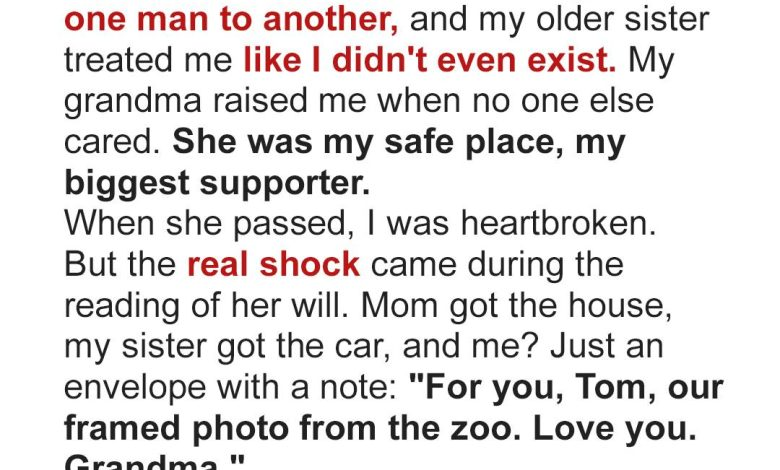
When my grandmother Grace died, I assumed the universe was playing its usual joke on me. At the will reading, my mother claimed the house before the lawyer even finished saying the street name. My sister Cynthia plucked the car keys off the table as if they’d been waiting for her their whole lives. Everyone left with something shiny or enviable.
Then the lawyer passed me a slim parcel—and gave me a pitying smile I immediately disliked.
Inside was a single framed photograph: Grandma and me at the zoo when I was six. My pigtails were uneven, my cheeks streaked with melted ice cream. A giraffe bent toward us, its eyelashes almost grazing my head. Grandma held my hand—steady, warm, unrushed. That was all. No heirloom. No check. Just an old frame with a crack down the side.
I drove home furious, convinced it confirmed what I’d always suspected: I was the helper, the invisible one, the kid who never made a fuss. I tossed the frame onto the table and walked away. Later, annoyed by the crack, I pried the backing off to fix it.
An envelope slipped free.
Grandma’s Last Gift — The Photo That Changed Everything
Sealed with lavender-patterned tape from her sewing box, it held stock certificates, banking records, and a single key taped to an index card. Underneath the key, in her looping script: For when you’re ready.
I wasn’t ready. But the next morning, I took the envelope to the bank anyway. A clerk brought out a safe-deposit box and left me alone with it. Inside were deeds to properties I didn’t know existed, logs of decades of careful saving and reinvesting—and the deed to the land beneath her house. My mother had assumed she’d inherited everything outright. But Grandma had left the ground itself to me. Deliberately. Quietly.
I cried harder there, in that chilly vault, than I had at her funeral. It wasn’t the assets that broke me open—it was the realization: I saw you. I trusted you.
With the inheritance, I bought the house back—land included. I gutted it. Ripped out old carpet, sanded the floors raw, scrubbed sunlight back into the rooms. I painted the front door the soft green of Grandma’s favorite cardigan. Slowly, the place became something else entirely.
The parlor transformed into a tiny lending library, its mismatched shelves sagging with books for anyone who needed them. The dining room became a soup-and-bread kitchen for anyone hungry or lonely. I named it Grace’s Corner and mounted a brass plaque on the front step.
Small-town word-of-mouth did the rest. Kids came first, sneaking in after school for comics and the apples I kept by the door. Then the adults followed—some shy, some exhausted, some grateful to have a space where they didn’t have to pretend to be fine. No forms. No fees. Just a meal, a book, and a chair.
Soon the rooms buzzed with life: whispered homework crises, bursts of laughter, heated debates about superheroes. Garlic and rosemary drifted into the street, drawing more curious neighbors inside.
One cold evening, as the radiator hissed awake, I set out two mugs—one for me, one for Grandma. I kept doing it. Habit. Grief. Love.
Months later, Cynthia appeared on the porch—mascara smudged, coat too thin. She didn’t ask for money. She asked if she could come in.
She talked for hours about bad choices, loneliness, the weight of pretending she had everything under control. When she finally stopped, I said, “I won’t hand you cash.” She stiffened, ready to argue. Instead, I slid an apron across the table. “If you want to stay, you work. Dishes. Prep. Register. Be someone Grandma would be proud of.”
She looked at the apron for a long time—then picked it up.
The next morning she arrived at seven sharp. She scrubbed pots until her hands pruned. She served soup with the tenderness of someone who understood that comfort sometimes mattered more than ingredients. She listened to a kid explain his science project like it was the most important thing she’d ever heard. At closing, she swept in careful, deliberate strokes and whispered, “I didn’t realize how much I missed belonging.”
Only then did it truly hit me: the photograph wasn’t a consolation prize. It had been a direction. Grandma hadn’t left me wealth—she had left me purpose.
The real inheritance wasn’t in ledgers or property lines. It was in the people crossing that threshold every day: nervous kids, worn-out parents, lonely elders, teens desperate for acceptance, siblings learning to forgive.
Some afternoons, when the house fills with voices and the radiator hums, I hold that zoo photo up to the light. The giraffe’s eyelashes glow. Grandma’s fingers still curl around mine. And Grace’s Corner radiates a warmth that comes only from the inside out.
My mother visits sometimes, bringing cornbread. She wipes the counters, listens to stories, lingers near the plaque on the step. We don’t mention the will anymore. We talk about who needs help next. Quiet mending. No explanations needed.
People often ask what my grandmother left me.
I tell them: Everything.
It just took time to realize that “everything” doesn’t always come wrapped in a bow. Sometimes it slips out of a cracked frame. Sometimes it offers a second chance. Sometimes it shows up in a room full of strangers who finally feel seen.
Grace’s Corner belongs to her as much as to me. Every steaming bowl. Every open doorway. Every well-worn paperback. Every person who leaves with a lighter heart.
All she left me was love.
Turns out, that was enough to build an entire life.