After My Husband Passed, I Charged My Stepson Rent, What He Had Been Doing in Silence Broke Me!
The quiet after my husband died wasn’t gentle. It felt invasive — like it crept into every room, every hallway, every object we had once touched together. For years, our world had revolved around his illness. Machines hummed through the dark. Timers for medication divided our days. I slept lightly, always alert, always listening for the next sound.
When it all stopped, the silence didn’t soothe me. It unsettled me.
The house that once felt protective suddenly felt cavernous. The stillness rang louder than any monitor ever had. Grief doesn’t simply break your heart; it rearranges your understanding of what normal feels like. Spaces that once held warmth can feel foreign when the person who filled them with life is gone.
Sorrow was quickly joined by fear.
We had drained our savings buying time. I would do it again without hesitation. Love doesn’t calculate expenses. But the world does. Bills kept arriving — methodical and unmoved by the fact that the name on them no longer answered.
When the condolence visits tapered off and the casseroles stopped coming, I was left facing debt, a house too big for one person, and a future that felt thin and uncertain.
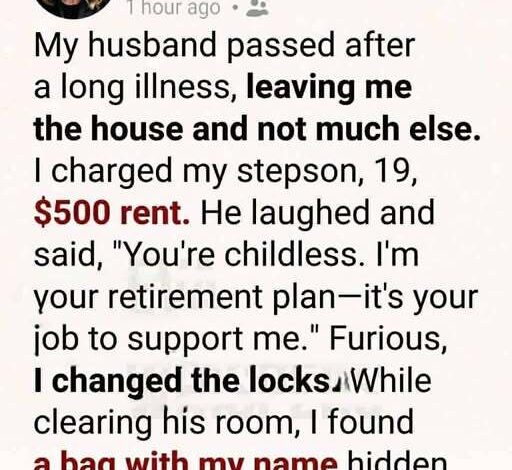
My stepson, Leo, was nineteen and still at home. He had lost his father too, but grief speaks differently in every heart. One evening, overwhelmed and ashamed of my anxiety over money, I carefully asked if he could contribute a little toward the household expenses.
He laughed.
Then he said something that pierced deeper than he knew. He joked that I didn’t have children of my own and maybe I should count on him as my “retirement plan.”
In my fragile state, the words felt like dismissal. As if the years of shared meals, parent-teacher meetings, bandaged scrapes, and late-night conversations meant nothing. Grief magnifies hurt. Instead of asking him what he meant, I pulled inward.
That night, pain hardened into fear. Fear pushed me to act.
The following morning, while he was at work, I changed the locks. I told myself I was safeguarding the only stability I had left. My hands shook as I began boxing up his belongings, convinced I had mistaken proximity for family.
Then I found the duffel bag.
It was tucked beneath his bed, old but neatly zipped. My name was written across the top.
Inside lay a savings book filled with steady deposits stretching back years. They weren’t large amounts, but they were consistent. Across the first page, in his uneven handwriting, were the words: “Mom’s Future Security Fund.”
My knees nearly buckled.
There was also a letter, dated for my upcoming birthday. He wrote about watching me sell pieces of jewelry, cancel vacations, and empty savings accounts to cover medical costs. He explained that he had quietly decided to start rebuilding something for me — a cushion, a safeguard. His way of saying thank you. His way of promising I would never stand alone.
The comment from the night before? It had been misdirection. He had planned to surprise me in just a few days.
Grief had filtered my hearing. I had listened through anxiety instead of faith.
When Leo came home and saw the locked door, I stepped outside before he could knock. I apologized before he spoke. I told him what I had discovered. His face softened — not in anger, but in quiet relief that the surprise hadn’t been entirely spoiled.
We stood there on the porch, holding each other for a long time.
For the first time since my husband’s death, the house didn’t feel vacant when we walked back in. It felt inhabited. Shared.
In that moment, I understood something deeply true: family is not defined by biology or titles. It’s built in silent sacrifices — in unspoken plans, unseen savings, and love that works quietly behind the scenes.
Grief can make us defensive. But patience reveals what fear hides.
That evening, the house was still hushed — yet it no longer felt heavy. It felt spacious. Spacious enough for forgiveness. Spacious enough for healing. Spacious enough for gratitude.
And within that stillness, I knew that even in loss, I was not alone.