A Simple Father’s Day Question From My Daughter Changed Everything—and Strengthened Our Bond
The drive home from daycare felt completely ordinary. Cars crept forward in slow waves, and the fading daylight painted the sky in soft gray-blue. In the back seat, my five-year-old hummed to herself, shoes tapping lightly against the car seat.
Then, out of nowhere, she spoke.
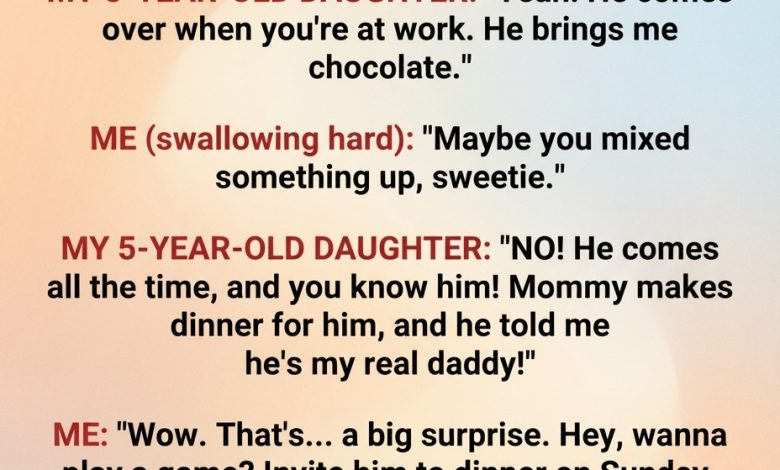
“Daddy,” she said casually, “can my other dad come to Father’s Day dinner too?”
Her tone was light. Almost cheerful.
The words, however, landed heavily.
I kept my eyes on the road. “What do you mean, sweetheart?”
She explained simply. A man sometimes visited when I was at work. He brought chocolates in shiny gold wrappers. He told silly jokes. He made her laugh. Then she leaned forward and added in a whisper that she wasn’t supposed to talk about it.
“It’s our little secret.”
My hands tightened around the steering wheel.
Everything I thought was steady—our routines, our shared meals, bedtime stories—suddenly felt fragile. Something had been unfolding quietly, and I had no idea.
I didn’t confront my wife that night.
Or the next.
Instead, I paid attention. I noticed small details I’d brushed aside before—late evenings at the office, phone calls that ended abruptly when I walked in, subtle tension I couldn’t quite name.
As Father’s Day approached, I made a decision.
I didn’t demand answers.
I added an extra place setting.
That evening, I cooked dinner like usual, though my pulse wouldn’t slow. My wife glanced at the fourth plate but said nothing. Our daughter, however, kept glancing at the door, barely containing her excitement.
Then the doorbell rang.
I opened it to find a man standing there with a small box of gold-wrapped chocolates in his hand. He looked uncertain, as if unsure whether he belonged on the doorstep.
Before I could say anything, my daughter darted past me and threw her arms around him.
Behind me, something crashed to the floor.
My wife stood frozen in the hallway, pale and silent. No shouting followed. The quiet was loud enough.
Later, after our daughter was asleep, the truth came out.
Years earlier, during a brief separation in our marriage, my wife had reconnected with someone she once loved. That short chapter resulted in our daughter. Afraid of losing everything, she returned to our marriage without telling me the full story. The other man—David—stepped away, believing distance was the least harmful choice.
But unfinished truths rarely stay buried.
As our daughter grew, so did his desire to know her. Occasional contact became quiet visits, justified as temporary. My wife convinced herself she was protecting everyone.
Instead, she was carrying a weight alone.
That night, there were tears—not explosive ones, but exhausted ones. Years of silence finally gave way.
I felt anger. Shock. Betrayal.
But I also felt something unexpected.
Perspective.
I thought about the nights I’d stayed up when she was sick. The scraped knees I’d cleaned. The bedtime books we’d read until she fell asleep against my shoulder. I remembered that fatherhood, for me, had never been theoretical—it had been daily.
The months that followed were difficult. Therapy. Hard conversations. Painful honesty. Biology was confirmed, but something else became clear too: DNA was only one part of the story.
We decided to stay.
We rebuilt trust slowly, with boundaries and transparency. David became part of our daughter’s life—not as a replacement, but as another adult who loved her. It wasn’t simple. It wasn’t conventional. But it was honest.
Time passed.
The next Father’s Day, my daughter climbed into my lap, wrapped her arms around my neck, and grinned.
“Happy Father’s Day,” she said.
And I understood something I hadn’t fully grasped before.
Fatherhood isn’t just about genetics.
It’s about presence.
About consistency.
About choosing to love, even when things are messy.
Sometimes the truth shakes your world.
And sometimes it clarifies what truly holds it together.