I Was Asked to Train My Higher-Paid Replacement, So I Taught My Boss an Unexpected Lesson
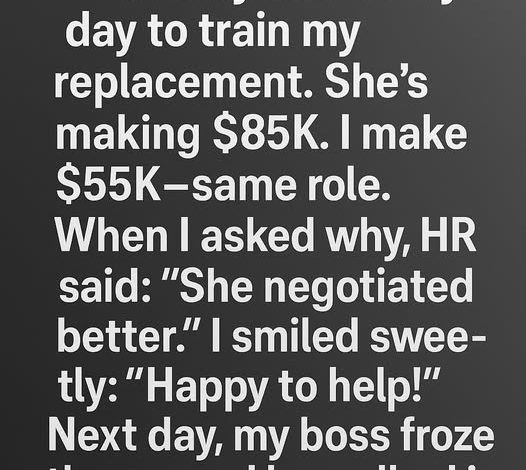
I realized something was off the moment my manager asked me to remain late all week to train the person who would be taking over my role. The request felt rehearsed and abrupt. What I didn’t expect was HR casually mentioning that my successor would be earning $85,000. I had been paid $55,000 for performing the very same job—despite years of experience and a consistent record of resolving problems others couldn’t.
When I raised the pay gap, HR simply shrugged. “She negotiated more effectively,” they said, as if that explained everything.
It didn’t. But it clarified a lot.
Composure, Not Conflict
In that moment, I didn’t feel rage—I felt clarity. If the company chose not to recognize my value, that was their choice. But they were about to see exactly what I had been contributing. I smiled and assured them I would train her thoroughly. My manager appeared relieved, assuming I would handle things as I always had. He had no idea what that would look like.
Documenting the Difference
The next morning, I prepared two stacks of documents in the training room:
• The official job description — a slim packet listing the duties formally assigned to my role.
• A comprehensive record of additional responsibilities — a much thicker compilation outlining the crises resolved, systems improved, after-hours fixes, vendor negotiations, and countless behind-the-scenes efforts that kept everything functioning smoothly.
The contrast was impossible to ignore. My successor examined the paperwork carefully. My manager’s confidence began to fade.
Training Within Boundaries
From then on, I trained her strictly according to the written job description. No informal systems. No custom solutions I had built during unpaid overtime. No extra processes that were never formally acknowledged. Only what the company had chosen to compensate.
When she asked how I handled escalations, supply chain delays, technical breakdowns, or vendor conflicts, I answered calmly:
“That would need to be discussed with management. It isn’t part of the formal role.”
Each response shifted more responsibility back to leadership.
The Shift in Perspective
By the second day, it was clear she understood the reality. She wasn’t replacing a single employee—she was stepping into a position that quietly absorbed the workload of several. She appreciated the transparency. She had been promised a manageable scope with strong pay. No one had mentioned that the role depended on invisible overtime and undocumented effort.
Meanwhile, my manager took urgent calls in the corridor. HR began sending cautious follow-ups. When asked to review “advanced processes,” I replied consistently:
“That falls outside my assigned responsibilities.”
For the first time, they were confronting the full scope of what I had been doing—while I was still there.
The Exit
On my final day, I completed the last task outlined in my official job description, then submitted a concise resignation letter effective immediately. No theatrics. No lengthy explanations. Just a professional conclusion.
My manager was visibly unsettled. My successor thanked me again for my honesty and wished me well. She wasn’t at fault—she was simply pursuing her opportunity. She deserved clarity, and I provided it.
What had once run quietly in the background now demanded direct oversight. The unseen safeguards were gone.
Moving Forward
I left feeling lighter, not vindictive. It wasn’t about retaliation—it was about self-respect. I had stopped letting an employer define my worth.
Within weeks, I accepted a new role with an organization that valued my expertise. This time, I negotiated confidently, supported by clear evidence of what I bring to the table. The compensation reflected that understanding.
The Lesson
When you truly recognize your value, you stop settling. You stop overextending for those who treat dedication as obligation. You stop believing you are replaceable simply because someone else secures a higher salary.
Replacing a job title is simple. Replacing genuine impact is far more difficult.