Homeless Mom Bought a Storage Unit Full of Junk — What They Discovered Inside Transformed Their Lives
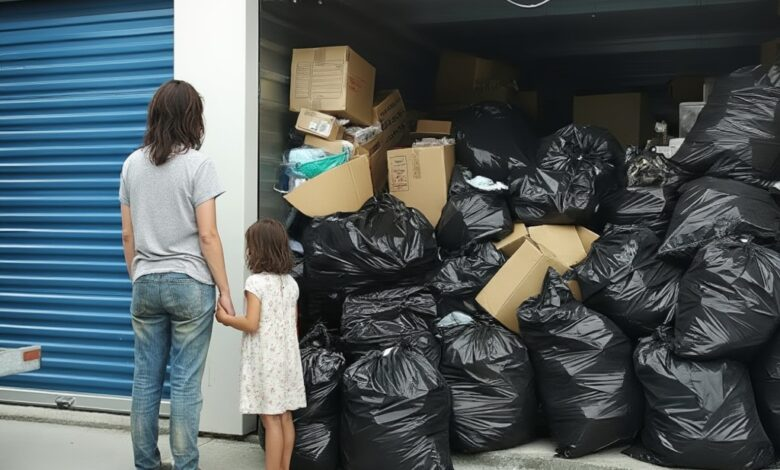
The first time Alicia Morales brought her children to a storage unit auction, she wasn’t searching for hidden riches—she was simply trying to escape the cold. February winds swept through Tulsa, Oklahoma, cutting through the thin curtains of the budget motel where Alicia and her two children—ten-year-old Mateo and six-year-old Rosie—had been staying for nearly three months. Everything had fallen apart quickly. The diner where she worked shut down without warning, unpaid rent accumulated, the landlord lost patience, and her car broke down beyond what she could afford to fix. By that weekend, they were drifting between low-cost motels and their aging Honda Civic, doing their best to hold on.
A paper sign taped to a telephone pole caught her attention: “STORAGE AUCTION TODAY — UNITS START AT $20.” The idea felt strange. How could she gamble on the contents of someone else’s abandoned belongings when she barely had enough to get by? Still, curiosity pulled her in. By afternoon, she stood at the edge of the crowd, gripping her children’s hands as metal doors rattled open one after another, revealing fragments of other people’s lives—some neatly boxed, others in complete disarray.
She had thirty-eight dollars in her wallet. Money meant for fuel, meals, emergencies.
Then the auctioneer stopped at Unit 27.
It looked hopeless. Broken furniture, damp mattresses, a bicycle missing its front wheel, dented lamps coated in rust. The bidding started at twenty, dropped to ten, then five. Without fully thinking, Alicia lifted her hand.
“Sold for five dollars!”
Mateo blinked. “Mom, did you just buy trash?” Alicia forced a laugh. “Maybe we just became treasure hunters,” she said, though doubt churned in her stomach.
She had forty-eight hours to empty the space. That night they slept in the car. The next morning, armed with determination, they began sorting through the clutter. The air smelled of dust and mildew. Most of it was exactly what it appeared to be—damaged cushions, outdated books, worn clothing. Still, Alicia pressed on. Five dollars might mean nothing—or it might change everything.
Near midday, Mateo tugged at a stack of old blankets and uncovered a solid wooden trunk. It was made of dark oak with brass trim, surprisingly intact. The latch opened with little effort. Inside were bundles of papers tied with string, several leather-bound journals, a velvet pouch holding gold and silver coins from the early 1900s, and beneath everything, a finely crafted violin.
An antique dealer confirmed the coins were rare and worth a significant amount. But the violin—a handmade Italian instrument dating back to 1923—was extraordinary. Its estimated value alone could lift them out of homelessness.
Yet Alicia didn’t rush to sell it. That night, she read the journals. They belonged to Leonard Whitaker, an immigrant who had come to America with dreams carried in music. He wrote about his journey, his devotion to a woman named Clara, and the crushing medical expenses that ultimately cost him his home. His final words were simple: “I hope whoever finds this understands that music is the only thing I ever truly owned.”
Alicia closed the journal with tears in her eyes. “We’re not selling the violin,” she told Mateo and Rosie. “It mattered to someone. We’re going to respect that.”
She sold the coins instead, securing a small apartment and a dependable car. The violin she donated to a local community center that offered music lessons to children who couldn’t otherwise afford them. Leonard’s instrument would continue to sing.
In time, Alicia was offered steady work at the center. Mateo volunteered as a tutor, and Rosie began taking piano lessons. Slowly, their lives steadied.
Months later, Alicia sat in the audience as a young girl stepped onto the stage holding Leonard’s violin. The first notes filled the room—clear, aching, beautiful. Alicia felt something shift inside her. The journey that began with five dollars had become something far greater than financial relief.
When people later asked how she managed to turn five dollars into a fresh start, Alicia rarely spoke about the coins. She spoke about the journals, the trunk, and the decision to honor a stranger’s story. The storage unit hadn’t been filled with junk at all. It held a life, a legacy—and in protecting it, Alicia found her own renewal.